Kristi Connects with Teen Orphans and Experiences a Small Earthquake

Guest Post from Kristi (and a few asides from me)

First of all, may I just say that I loved spending time with a good friend…even if that meant time combing lice out of our hair, attempting to salsa dance with rhythmic Colombians about two feet shorter than us, experiencing our first Earthquake, or cuddling some adorable orphan children.

(Keely aside): as yes, the earthquake. I had forgotten to tell you all about that little surprise. It happened sometime during the night. To me the experience continues to be a blur as I did not ever totally wake up– I instead had a dream that explained the movement as a very strong wind. And for some reason… this seems to be the prevalent explanation in my mind to date. I actually have to remind myself that the wind can not in fact shake a building, that we lived through a very small earthquake– our first ever by the way. Kristi however fully came to and tried to get me to pay reverence or at least acknowledge the event… no dice.)

The first day on our way to the orphanage Keely said to me “I love being this engaged in my life.” I left with that same attitude simply by seeing the amazing human spirit through the kids I met. I am such a sucker for teenagers and I left feeling for the difficulties teenagers encounter living in an orphanage. Therefore, I am going to share this with you as Keely does an amazing job of sharing about all those babies:).

As, teenagers we have so many crazy emotions/hormones you name it and it is hard enough when you have a positive role model to go to. No one is available to help with homework (They can’t call a friend for help as they have no phone), no one is there for boy/girl troubles, no dating, and maybe most importantly there is no one to teach “life skills.” I can’t imagine never having dealt with money, jobs, transportation, grocery shopping,…..LIFE, before being on my own at 18 like these kids will be. On my plane ride home I could not get a few of the teenage girls I met out of my head and just wish there was some way to give them a hand through the trying life outside the orphanage.

Kristi helping with English homework-- man our language is hard to learn

(Keely aside) The thing that amazes me most about these kids is that despite all this, the majority of them area GREAT kids. That is why it is so easy for visitors like Kristi (Janet, Lisa, Sabrina… me) to come and fall in love with them. They are engaging… and they are seeking someone to connect to. I know I have said it a million times, but the perseverance of these kids, of their human spirit, it never ceases to amaze me.

Columbia is a beautiful country where nearly everyone I met was extremely kind. However, upon my arrival home I was thankful for one thing… a hot shower. I know this is not the last time I do something like this….hopefully Keely finds a way to keep with this journey so I can come once in a while. It was truly eye-opening and wonderful at the same time.

Thanks for reading,

Kristi

Marshall and Whitney visit Bulgaria

Bulgaria Day 1 and 2


Greetings from Bulgaria! Marshall and I traveled all day on Wednesday to get to Sofia, Bulgaria. Then we connected with Rosi, a member of our incountry team, and hopped on a flight to Bourgas, Bulgaria. On Thursday, we visited the orphanage for infants in Bourgas. This orphanage housed about 160 children ages 0-3 We were very pleased with the condition of the orphanage and how well the children were taken care of there. We met with the orphanage director and she told us she was very interested in providing for the sensory and emotional needs of the children in the orphanage as well as creating a family type enviornment for the children with special needs.

After visiting the orphanage, Marshall, Rosi, and I were driven to Varna, Bulgaria and we were able to walk the "board walk" in Varna which is a city on the coast of the Black Sea. On Friday morning, we visited the orphanage in Varna. Again it housed around 170 children ages 0-3. The Varnas orphanage had a fire in December and is still making repairs. We were able to see the progress that has been made. I was pleased to see that the orphanage director is passionate about raising money to make the needed repairs quickly and that she hopes to make the orphanage even better than before.


After visiting the orphanage we hopped on a plane and flew back to Sofia. We were picked up at the airport by Petko (another member of the Vesta team) and we drove straight to the office to talk with Milena (our in country lawyer). Milena informed us of the progress of the program and also gave us a few updates.

Can We Fix It?

Bob the Builder… Can we fix it?

Keely's words of wisdom

Bob the builder, yes we can!

I don’t know if Obama and Bob the builder had a feud over this little phrase or not. But either way, I think that they are both onto something. It’s the question that I ask myself everyday and hope, oh how I hope, that the answer is in fact- yes we can. There may be some of you that have heard my “shpeel” but I am pretty sure that most of you have not. The shpeel I refer to is my way of explaining my intentions, my interactions, the big picture that I dream of for these institutions that I am working with: to help the many many children in this world living without parents. So here it goes:

The Problem:

We are currently living in a world with almost 145 million orphans. A number that may be deceiving because often the term “orphan” refers to children who have lost their parents to death, abandonment etc. But the figure more than likely does not include the millions of kids (even in the US) that are living parent-less (or family-less is perhaps a better way of putting it) because they are under protection of the state. It’s a daunting figure. I have always said that kids are a unique population because they are one of the few that can not advocate for themselves. They rely on us, on adults. This is a problem that we, as adults, should not/can not ignore.

There are many groups of people/organizations/governments who are fighting for these kids. The efforts to address this problem is and must be multifaceted. There are organizations working to bring peace to war-torn regions, others improving health care, education on pregnancy prevention, micro-financing and economic stimulus, and much more… all huge factors contributing to the problem of family-less children in this world. You have adoption agencies (both domestic and international) working to bring some of these children to loving families. BUT, you still have millions of children living in institutions, a number growing every year. While all other groups fight from the outside in, it seems to me what is especially important about the work that I am doing here, is working within the system…. fighting from the inside out. We are working inside these homes, to make them supportive environments where children can grow and flourish.

Don’t misinterpret me… I absolutely believe that a loving family is better than and institution. But for many children in many countries, institutionalization is the only option. So we have to make this option the best it can be. And hopefully one day, it will not have to be an option anymore. Until then… the war has been waged.

So whats the point?

The point is that if we can love these kids, teach them to love, to trust, to learn… if we can help them become productive citizens that contribute to society. Help them become responsible, healthy, employed people then maybe the next generation will have less parent-less children. The alternative?– they get kicked out of an orphanage at 18 have no life skills, limited empathy, no idea how to handle money or live on their own… spend everything they have and end of having to make money in horrible unimaginable ways such as war, drugs or prostitution– having 6 babies, the next generation of orphans is even larger than the last… I think you see where this is going.

The breakdown (or build-up)– how do we help these institutions? We are building a house, a home, a life, for these kids (This is where the Bob the Builder analogy comes into play).

We start with the foundation: The foundation is the basics of keeping the kids alive- health care, nutrition, safe lodging, diapers, weather appropriate clothes, clean drinking water, etc. It’s the bare minimum. And you can’t build a house on a rocky foundation. You can’t invest in quality of life projects like education and career training, if there is not enough formula for the babies that last few days of every month. Money must first be invested here to make future projects sustainable.

Next is the walls: this is the developmentally supportive care. In Spanish they use the word stimulation to describe this pro-active care. Basically it is giving kids the attention, affection and opportunities that they need to learn. Huge amounts of research and millions of governmental dollars are invested in improving the early years of life in the US. We understand this sensitive period of development is hugely important to setting the stage for learning and succeeding later in life. This is a HUGE part of what Super Kids invests in. And it is basically as simple as this: you have to experience to learn. You have to be spoken to in order to learn to talk, you have to be out of your crib in order to learn to walk, you have to be loved to learn to love…. we help orphanages develop programs and infrastructure to allow, and hopefully even encourage, these kids to learn.

A huge part of building the walls, includes teaching caregivers and staff how to work with the children with disabilities. Often there are large numbers of children in institutions who have physical disabilities (not just talking about “orphanage delay” here, but chronic disabilities) for a variety of reasons. And often these children experience very little personal interaction. Not because the caregivers are cold… but because these kids require SO much assistance– there is just not enough time. These women are taking care of 30 kids, it’s just a pure matter of resources. They do not have the time or equipment to keep these kids engaged often leading to very stiff little bodies that barely move, sickness, and definitely unrealized potential. We work hard to educate, dispunge stereotypes about abilities of children with special needs, equipment provision and training to allow these kids to participate with their peers.

The windows: the windows are education. Yes, we are building a house. But it is CRUCIAL that these kids begin to understand that there is a world, a society, with very different rules outside the walls of their institution. An education is very important to the overall goal (remember what that was after all my rambling?… to make productive citizens). Many many institutions work hard to help children across the world recieve an education and this population of kids should not be forgotten in these struggles.

The roof: The roof is life skills training. At 18 (in some countries it is a little older) The doors open and you are forced to leave your home. The institution you have been raised in. And you are expected to know how to survive. The problem is– orphanages themselves are a culture. They have very different rules, norms, than society at large. Some examples: There is no money in orphanages… these kids have no idea how to budget, understand saving and spending. Limited independence… they are cared for on all levels and so often do not know how to cook, clean, etc. because someone has been doing it for them (this is can be the polar opposite in some places with children helping with daily chores… but this is generalized for example purposes). And they definitely do not have a trade skill. They often don’t leave with any tools to help them get a job or keep a job.

So the roof is thus finding ways to teach these adolescents these skills. And the REAL success is when the roof can help protect the rest of the house- when it can lead to self-sustainability. For example: teaching adolescents to garden and using the food to feed the orphanage, teaching them crafts and selling them to support the projects, training adolescents to be caregivers etc. AND giving them opportunities to experience the outside world by going on trips, learning to navigate the bus system, learning to go shopping. Just think for a minutes about all the things that you do in a day– how did you learn how to do them? who taught you? if you lived in an institution with 100 kids and never got to leave beyond the gates… would you have these skills?

So that is the house. And when you have all these aspects fully incorporated, with sounds structure. Then you can really protect and nourish the kids inside of them. Can we fix it? I sure hope so.

Thanks for reading

KO

Gladney VP Marshall Williams travels to Czech Republic

Czech Day 3


Today Marshall and I traveled with Lucie and Martine to visit two orphanages today. The first was a orphanage for children 1-3 years old. It was about 30 minutes outside of Brno. It was a very well run orphanage. The walls were painted in bright colors, the caregiver ratio was 1 to 3, and the staff really seemed to be looking out for the best interest of the child. The orphanage director welcomed us and spoke to us about how the orphanage is run and how they assist families in taking care of the children.


We then drove back to Brno and had a quick lunch. After we went to an orphanage for children over 3 years old. Again we were very please with the way the orphanage was run. There were 21 children that live there and they live in 3 "family" units. Each family unit lives on one floor and each floor has a kitchen, living room, and then bedrooms for the children. It was a very neat concept to see.

Marshall and I have learned over the last two days that the Czech goverment is really invested in keeping families together. The government has many programs in place that enable parents to work through the issues they are faced with. Also, we learned that about 500 domestic placements are done each year!

After our visits, Marshall and I picked up our bags from the hotel and headed to the train station. We rode the train back to Prague and will stay here for the night. We fly out early tomorrow morning to Sophia, Bulgaria!

A big thanks goes out to Justin L. He has really helped us get around the last two days and has shown us a new side to Brno!

Monday, March 21, 2011

Czech Day 2

Today Marshall and I met Justin, an American missionary that lives in Brno, who escorted us to our meeting with the officials in charge of adoptions in the Czech Republic. We had a really good meeting and we talked a lot about thier systems for adoptions and they were particularly interested in how we support our families before and after they take placement. Tomorrow we are going to visit two different orphanages one in Brno and one about an hour away.
After our meeting, Justin took us to a lovely little French restuarant run by nuns. It was very very good. I had onion soup and a spinach crepe. Marshall had chicken noodle soup which looked like high class ramen!
After lunch, Justin took us walking through Brno and told us a little bit more about the city. Brno is the home of Mendel who came up with genetics. We ventured up the very steep hill to Spilberk Castle. It's very small but has wonderul views of the city. Justin also let us know that we are so very close to Vienna which I didn't know. Brno is a merchant city it has one of the largest trade shows in Europe and we saw that building from Spilberg as well.

Its been a busy day, but I'm looking forward to tomorrow!

Keely Lands on Her Feet in Peru

20 03 2011

Phone call– me and mom:

Me: Good news ma. I am safe and sound in Lima, staying with an amazing family with two adorable little girls.

Mom: Oh good. I was a little worried this time, but it looks like you landed on your feet…again.

Let me fill you in a bit. The short of it is: I left Colombia on said deportation day (March 11th) with basically no idea where I was going to stay when I got to Peru. Well, that is not totally true. That morning, before I left, I started getting a little nervous and thus got online and made a 2 night hostel reservation… just to assure I had somewhere to go. I got here late friday night and headed to the hostel. Next day arranged to have lunch with Giuli (more on her later, my volunteer contact here in Peru) and by the end of the evening Saturday, she had made a few calls a friend of a friend over-heard the convo in the car and before I knew it I was getting a tour of my new home. So here I am, happy and safe.

I have been reflecting a lot on that statement “landing on your feet.” But more, I guess the luxury, the luck, to have the faith that I will land on my feet. But even more… the luxury to jump in the first place. I am referring to the ability to take risks, follow my dreams, travel… to be the modern-day nomad that I am.

My experiences here in Lima have made me keenly aware of just how lucky I am to live my life this way. And most of that resolves around a community of Lima, Pamplona, that I am quickly falling in love with. I first heard about it as Giuli and I sat in her livingroom talking about all the amazing projects of Buckner Peru. Giuli is an art teacher… that now works for Bucker Peru wearing several hats including working with volunteers/mission groups, follow-up and she spends lots of her time “in the field” working with children in several orphanage/institutions and children at-risk in low-income communities. I loved hearing all her stories and projects. But the one that immediately grabbed my attention is an amazing prevention program they have started in a small area of Pamplona. They are working with 80 families in this sector of the city. At its most basic root, it seems to me, they are working to give these families, these children, hope. They are allowing them to dream, develop an identity, to value themselves. They are working to help them realize, truly believe, that they can achieve more. They are working to change the mentality such that these 80 families no longer sit idly with their hand in the air and request humanitarian aid,no, they are helping them organize, open their world view, and realize that these people– these 80 families in this few blocks of the city– can do it themselves. They are doing this through amazing creative ways: art, education, community projects.

Pamplona, bottom of the hill

Top of the hill... all those structures are houses

Giuli has helped me jump right in with this community. Today she and I gave a full day course for the almost 60 preschool teachers in Pamplona. There is a government program(which to my understanding appears to be very similar to headstart) that “supports” these programs. “Supports” being in quotes because they basically provide the bare minimum– a roof, a few tables, a few books and toys. The teachers are amazing, strong, animated women… but they are not teachers and have no formal training, they are women from the community committed to the future of these kids. They receive almost nothing and work very hard: there are 20+ students (age 3-5) for 1 teacher.

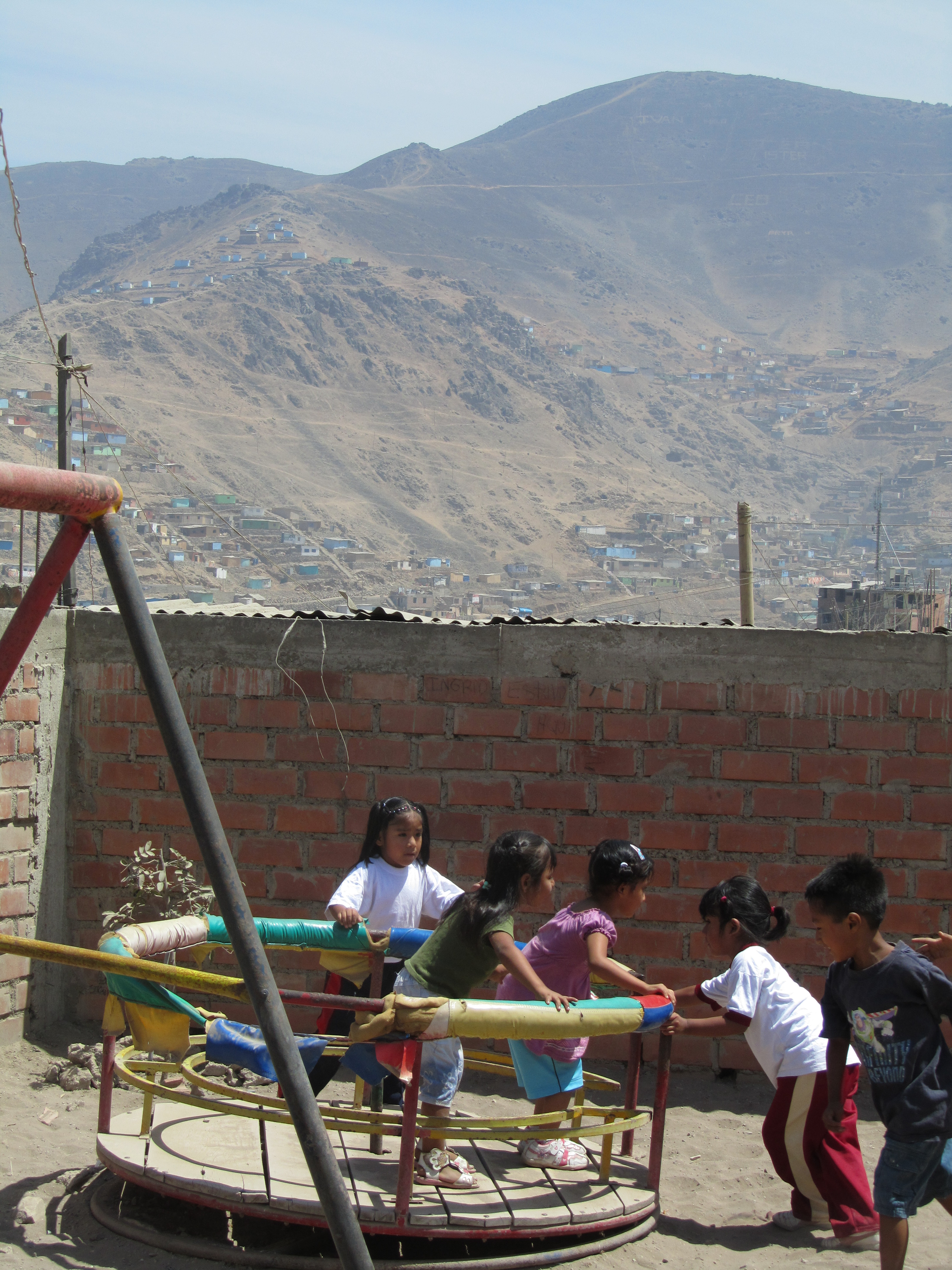
Preschooler outdoor play time

More recess

Burning some energy... choo choo train in the street right in front of the school

So today we covered preschool teaching 101 on 6 hours. They loved it. I of course want to stay and keep working with these women. I will spend a few days next week observing various classes to help them put into practice some of the things we discussed today. But there is so much to do. And they are so eager to learn.

Giuli working on puppets with afterschool group

I will also visit a few orphanages while I am here, including a special needs orphanage with over 100 children with disabilities. It’s quite an impressive place with lots of therapists and qualified care-givers. It has definitely been quite an experience!

And yes, the icing on the cake of my Peru experience, my new “land on your feet” family. They are so amazing. I have felt at home since the minute I arrived. We have had slumber parties, homework parties, art sessions, watched movies. They have taken me all around Lima to show me the big sites. And I really think that it is their personal mission as a family to introduce me to as much peruvian cuisine as possible (which I of course do not mind at all…. and neither does my stomach, butt and thighs). So in return, I have introduced the family to exercising. We take family runs at the park (which the six-year-old said was the “best day of her life”). It is relationships like these that make traveling so special– it’s about jumping, risking, and getting really lucky sometimes to land on your feet.

The fam... before one of our many feasts. Homemade ceviche.

Pajama party.... post blindfolded make-up game

Thanks again for all the support!!! Miss you all.

KO

Gladney Waiting Child Webinar this Thursday

Special Gladney Webinar

China Waiting Child Adoption Program &

March 2011 Superkids trip to Shanghai Children’s Home

Please join us for this special webinar featuring two child development therapists who recently visited the Shanghai Children’s Home for a one-week trip to train orphanage staff and meet some of the children available for adoption through Gladney’s Waiting Child program. This webinar will be a wonderful first-hand account by Pat Marcus who is an occupational therapist, and Kathy deMaCarty who is a speech therapist, about all they did during the course of this important trip sponsored by Gladney’s SuperKids Charity.

The webinar will be held on Thursday, March 24th at 8pm EST. Space is limited so be sure to register for the webinar today!

Project Play Continues

13 03 2011

I can’t even believe how this project continues to move forward. We worked the last two weeks giving the adolescents 1 on1 sessions assisting them during their play sessions with the little ones on their “caseload.” It was so much fun. I continue to be thrilled with the supervisors, Ana Maria and Wan Su (physical therapy students from Cali in their final few months of school). They do such a great job assisting the adolescents and keeping the session moving. Mostly I just love their attitudes– they are doing a great job. Here are a few quick pics of the adolescents conducting the play sessions.


Right before I left, we had a little party to kick off the program. We invited all the staff, ate Doritos and cake, and signed the contracts. This was a pretty significant moment for the leaders (adolescents) because from this point on, they will be receiving payment for their work. Also, I surprised them with the awesome t-shirts that I had made. They (of course) loved that too!!

The ProjectPlay crew with Cappie

I am really proud of how the workers at the orphanage are embracing this project too. Last Thursday, I finally officially presented the entire program to the psycho-social staff. They all were very supportive and thought it was a fantastic idea. In fact, one social worker commented that she had already seen a change in the way that the adolescents were addressing the younger kids in the institution– with more interest and acknowledgment. The director of the orphanage told me about several of the adolescents visiting her a few days before teaching her about motor development of infants and gross motor activities you could do to strengthen development (and they were using this type of language to talk about it. And one of the psychologists had a fantastic idea: they could have monthly meetings with the adolescents to talk about the progress of the children and treatment ideas. She saw so much potential in the project, they she wanted to be more involved. She talked about how it would help the adolescents but also how a meeting would help her and the other professionals and they can inform the professionals about changes they are observing to make their tri-monthly evaluations more accurate.

And everyday there are more and more kids interested in participating. Right now, only those that are 13 and older are able to be leaders. However, there are 4 younger girls (11 and 12 year olds) who are VERY interested in participating and have been involved and helpful throughout the entire training process. Thus, Ana is going to give them “future of ProjectPlay” classes every week. They will not be official leaders and will not receive pay, but they will work with Ana and learn about development, how to fill out the forms, develop their skills working with the children and will eventually age into the program.

I left feeling really good about what we were. And now they have about a month “trial period” while I am in Peru to see what hiccups there might be… and then we can brainstorm changes once I get back.

Once again, thanks to all of you who have had a role in making with program happen. So far it has been a great success!!

KO