About Special Needs

As a follow up to our webinair featuring the JiangXi children here is some of the information plus a few more details in a quick reference guide

Cerebral Palsy
A non progressive disorder caused by an injury to the neurological system, immediately before,  during or right after birth.  Can cause difficulty with motor movements such as weakness, stiff muscles or abnormal movements, and can have symptoms affecting other areas of development.

Limb differences
can be anything, everything from missing fingers and toes, webbing between the digits or missing most of a limb.

Seizures
Abnormal electrical activity in the nerve cells in the brain causing loss of consciousness, unusual sensations or behavior.

Albinism
In these children, the body unable to produce or distribute melanin, a natural substance that gives color to your hair, skin, and iris of the eye.  These children may have vision issues or difficulty with perception.  Sometimes they also have developmental delay because vision plays a huge part in development.

Spina Bifida
there are several different types of Spina Bifida.  It is caused by incomplete formation of the spinal bones, covering of the spinal nerves or spinal nerves being unprotected by the spinal bones.  This conditions can result in difficulty with walking or moving.

Congenital heart defects
May be anything from minor or major in nature.

Cleft lip/ palette

A cleft palate is an opening or split in the roof of the mouth that occurs when the tissue doesn't fuse together during development in the womb. Cleft palate often includes a split or cleft in the upper lip (cleft lip) but can occur without affecting the lip.  A cleft can also extend into the gum area causing a split in ridge above the teeth.

Join us for part two of our webinair featuring the children from JiangXi.  Follow the link below to register.   www.asiawaitingchild.wordpress.com. And click on the register for webinair link

Peace,

Pat

Trains, Planes and Brujitas


As I spent Sunday on a day trip partaking in the strangest form of transportation I have ever experienced, I thought I would take the time to describe that event and the other forms of transportation native to Colombia. From most frequented to least (least being Sunday’s wild ride), here we go:

Bus

I travel to and from Chiquitines and most other places I need to go here using public transportation. The main city system of public transportation is called the Mio and for the most part, it’s very reliable and sophisticated. In fact, Cali’s public transit system was implemented a few years ago following the pioneering design of Bogota’s rapid transit system .According to this model, the four center lanes of main thoroughfares are dedicated to bus traffic only, and you enter the bus system through your station’s turnstile, then ride where you need to on the same fare until you exit a different turnstile at your destination. Fares are inexpensive at 1600 pesos (less than a dollar) per trip and the buses are modern and in good condition. Despite the seeming order of the system though, there are several factors that make the Mio an adventure in itself some days.

For starters, it is usually packed. And when I say packed I mean smashed up against the glass door, stranger’s bossom in your face kind of packed. In fact, every time I think it can’t be more full, Mio defies all odds to prove me wrong. Add to that how it is customary to push and shove your way onto the bus filled way beyond capacity and it is that much more unbearable. Luckily I have grown more or less accustomed to this routine though. I can now stand my ground with the best of them. I have not yet gotten used to how the bus is designed to accommodate tiny little Colombians and not giant Americans like myself, however. I hit my head on the overhead grab bars as I exit on a daily basis and have to jam my knees toward my chest in certain seats.

To get a better picture of what it’s like to be a foreign giant on the Mio, check out Keely’s description. That particular experience was the most entertaining commute I’ve had to date and it happened on a day full of chaos and congestion as the drivers of the smaller buses in Cali were striking because of the Mio’s plans to take over their routes and replace their buses. The drivers’ fears of job loss were mostly founded. However, there is good cause, at least in my opinion, to clear out the smaller bus system.
Based on my one experience with the smaller bus system, I’m ready for them to go. While they will stop wherever you would like them to on the route, they are tiny, old, falling apart, polluting and quite frankly a little terrifying.  They zoom in between lanes pulling over whenever they feel like it while you hang on for dear life and hope you’re going in the right direction. There’s typically a passenger (who knows how he is selected to his position) who plays the part of blinker as well by hanging out the door to wave traffic off. As Magnolia stated, this guy is not asking you to let him pass, he’s telling you that he’s going to take three lanes at a time to make his exit whether you like it or not. Watch out world.

Taxi
A twenty minute ride in a taxi here costs a whopping six dollars. Six dollars. While hesitant to use taxis in the U.S. (when in cities big enough to have them – Iowa girl here… ), I am all for calling a taxi here when in need. They are tiny and also tend to swerve through traffic but in a way much less distressing than the small buses. I’ve been warned to call a taxi service when needed and not to catch a random cab from the street because of safety issues, but overall, they are the ideal way to get from point A to point B here.

Car
My host family doesn’t own a car but Angelica’s parents do and I frequently hitch a ride with the Chiquitines doctor to the bus stop after work. Like most other places outside of the SUV-loving U.S., cars here are small. They are mostly compact little things like the Ford Fiesta, Chevy Aveo or any number of Renault vehicles. Don’t let their size fool you though – like the buses, Colombians sure know how to fill them up. On one otherwise non-eventful Sunday here a few weeks back, we fit nine people and a dog in Angelica’s mother’s car. Nine. Granted, two of them were children but still. Nine. Don’t for a second think that we drove more cautiously because of the cargo either. We proceeded to zoom through traffic, occupying two lanes at a time, honking at every intersection, tapping the brakes at stop signs and never ever ever using a blinker as we traveled to our destination. Pretend you never read this, Mom.

Brujitas
By far the most interested form of travel I have encountered here, the brujitas of San Cipriano are a class of transportation in and of themselves. Imagine that on a day trip to the river after spending two hours traversing windy mountain roads, you arrive in a tiny little town. The tour guide leads you toward a set of railroad tracks a few blocks from where the bus leaves you and you find yourself looking around in puzzlement, as there is no train in sight. All you can spot are these tiny little platforms resembling a couple of wooden pallets nailed together, with wheels on the bottom, a crude wooden bench on top, and a motorbike equipped with only one tire attached. There’s no way that’s how we’re getting to the nature reserve, right?

Wrong.

At this point one of the most terrifying/entertaining rides of my life began. These wooden platforms were indeed how we were to arrive at our destination. On our tour guide’s command, we squished a minimum of twelve people on one of these things and hung on for dear life as the driver, AKA the guy revving the motorbike as the back wheel turned over the rail, started us off. As there wasn’t any place to hang onto though, we really just tried to think skinny and low to the ground as we started picking up speed. Despite the fact that we were going thirty miles per hour without any kind of safety anything, the ride was actually pretty comical. The group in front of ours had to get off and push their platform when it couldn’t make it up a tiny incline and five minutes after we had a laugh at them, our motorbike ran out of gas. Our driver was kind enough to push our platform the fifty yards or so to the next place he could fill up, however (with a jug of gas brought out by a guy sitting on his patio next to the tracks), so we didn’t have to break a sweat.


The brujitas are actually the only way to travel between towns in the area we were visiting, as there are no roads to connect them and the area suffers from extreme poverty. Did I also mention that it’s an active rail line? The whole time this was going down, I was praying that a train wouldn’t come barreling around the next curve. Or if it did, that at least it would sound it’s horn long before then. As we crossed a handful of bridges over small to moderate-sized rivers with the trestles no more than six inches from our toes and the drop off to the water just beyond those, the praying intensified. God save the brujitas.


 Again, pretend you never read this, Mom.

-Abby


Change Part 3

For instance, my most recent project has been developing a care plan for a two-year-old little girl who has severe brain damage from meningitis. After talking to the auxiliaries about her daily cares and their time commitments, I learned that they realize she spends too much time on her back, but they don’t know how to position her differently. I also learned that my best shot at increasing this little one’s quality of life is in finding a volunteer to dedicate herself to her therapy and bring others on board as well. Since then, I have been overwhelmed with the support and interest of staff in the well-being of this little girl. Last week at their request, I sat down with the doctor and head nurse to discuss my thoughts on her functioning and what could be done to give her the opportunity to progress. I was also able to spend a morning working with Libia, resident super volunteer, taking pictures for positioning and stretching programs she and the auxiliaries will implement. It has truly been wonderful to see everyone come together to make this little girl’s life better, and I think it is a very concrete example of what can happen when everyone is on the same page working together for a shared purpose.


Libia trying her hand at some of the new stretches
High tech positioners (burp rag, anyone?) to keep her thumb in a better position and prevent contractures
If this much good can transpire in one week, I can’t wait to see what happens in the next.

To top it all off, this little guy, who received new braces from Keely and turned two last week, walked solo for the first time today! Life is good.

-Abby

Change Part Two

 As the volunteers showed that they were in it for the long haul, I found that the auxiliaries, who are responsible for all of the babies’ medication, feeding and hygiene, also started to tiptoe into the therapy scene. I am very proud to say that the tummy time phenomena has now extended past the volunteers to nearly all those involved in the development of the younger kids. For the last week, the mats have been out and heaping with little ones, toys and adults from breakfast until dinner. It’s not only volunteers doing the work either. Today I found an auxiliary putting out the mats before a volunteer could get to it, and it seems like each day more and more professional staff (psychologist, doctor, head nurse, social worker, etc.) leave their offices to at the very least stroll by the play area and coo at a few children. The auxiliaries have also started lingering around the edges of teaching moments between myself and volunteers and posing hesitant questions about the children’s care. In the last week, I have found these questions to be great starting points for further conversation. While talking about the pandiolas, the discussion moves to reflux. “Hey I’ve actually been working on some positioning devices to help with that. What do you think about this?” Or when an auxiliary asks why the one year old spits out all of the solid pieces of his food, I’m able to explain his oral motor delays, validate that it is understandably difficult for her to give that child the time he needs to learn to tolerate new textures and let her know that the other volunteers and myself are able and more than willing to lend a helping hand. As I look for feedback on the new supplies that have arrived at Chiquitines recently (see pictures below), I’m able to get a better picture of what will actually be used and how I can change things to make it easier for everyone involved. Once the auxiliaries see that I’m on their side, I’ve found them more open to suggestions and willing to give input into my projects.


Thanks to the generous donations of friends and family, this tiny table arrived at Chiquitines last week. The perfect size for working on feeding, fine motor activities and cruising with the toddler group, it is a great addition to the stimulation room.


Gabriel, my host brother, was kind enough to accompany me to the city center last week to buy foam for some reflux positioners I wanted to make. Getting the foam back to the apartment was quite the adventure.


This itty bitty baby, who is only a week old, arrived at Chiquitines last week to a crib newly fitted with an inclined wedge to assist with reflux. Compared to the old method of using rolled up towels beneath the mattress, which caused the babies to frequently slip to one side against the walls, the new foam is a big improvement.


 Getting the completed wedges (which I promised I used for my personal enjoyment just once) to Chiquitines on the bus was another adventure. As if I didn’t stand out enough as a giant foreigner, let’s add a massive unidentifiable homemade contraption…


Change Part One

Only a week has passed since I last wrote about Chiquitines but it seems like far more, as so much has changed – in ways that are readily seen and not so tangible.


For the first month of my time here, I found myself very preoccupied with the seemingly unbreakable cycle of care the little ones here receive.  The caregivers at Chiquitines love the kids and would do anything for them. However, there exist some critical habits that put the kids at a disadvantage from developing in the same way a child raised in a traditional home does. For the better part of the time I have spent here, I felt like breaking that cycle was impossible. “How does one young, recently graduated therapist without the natural rapport that comes from being a native speaker and resident, convince a well-oiled machine to change some of their habits?” I would ask myself.

Ever so slowly, mostly in the last week, I realized I was asking the wrong questions. I don’t need to show the people that care for the kids day in and day out that they are doing things wrong. I don’t need to look for a way to implement system-wide changes that I think will help the kids but that will most likely lead to conflicts of opinion and ultimately lack of compliance as soon as I board my plane back to the U.S. What I need to do is join their side.  What I need to do is praise the good things that are happening and meet the caregivers where they are - give them practical, easy-to-implement ways to meet both their needs and those of the little ones.  Last week brought a whirlwind of small changes that I hope and pray will endure long after I’m gone.

After meeting with the volunteers the previous week, I was bombarded with therapy questions last week. And it felt fantastic! Nearly every day, several volunteers would ask me, “Did you see so and so crawling? Isn’t that great? Now what’s next?” Or “Abby, can you show me what you’re doing with this little guy I work with?” Many more asked about feeding too, as that was a much-discussed topic in our little get-together, and stuck around the lunch hour to learn and to help.


Volunteer education on advancing the goals of this little guy after achieving propped sitting balance


Demonstrating feeding techniques with an eight month old with food aversion and tongue thrusting (not included: the dozen or so pictures of said eight month old in tears battling said feeding techniques as she struggles to tolerate even two ounces of pureed passion fruit…)


And so ends another feeding session


 Abby


Lessons Learned

Remember lesson number one from my last post? It must have rang home loud and clear because when I arrived at Chiquitines on Friday morning, this is what I found:


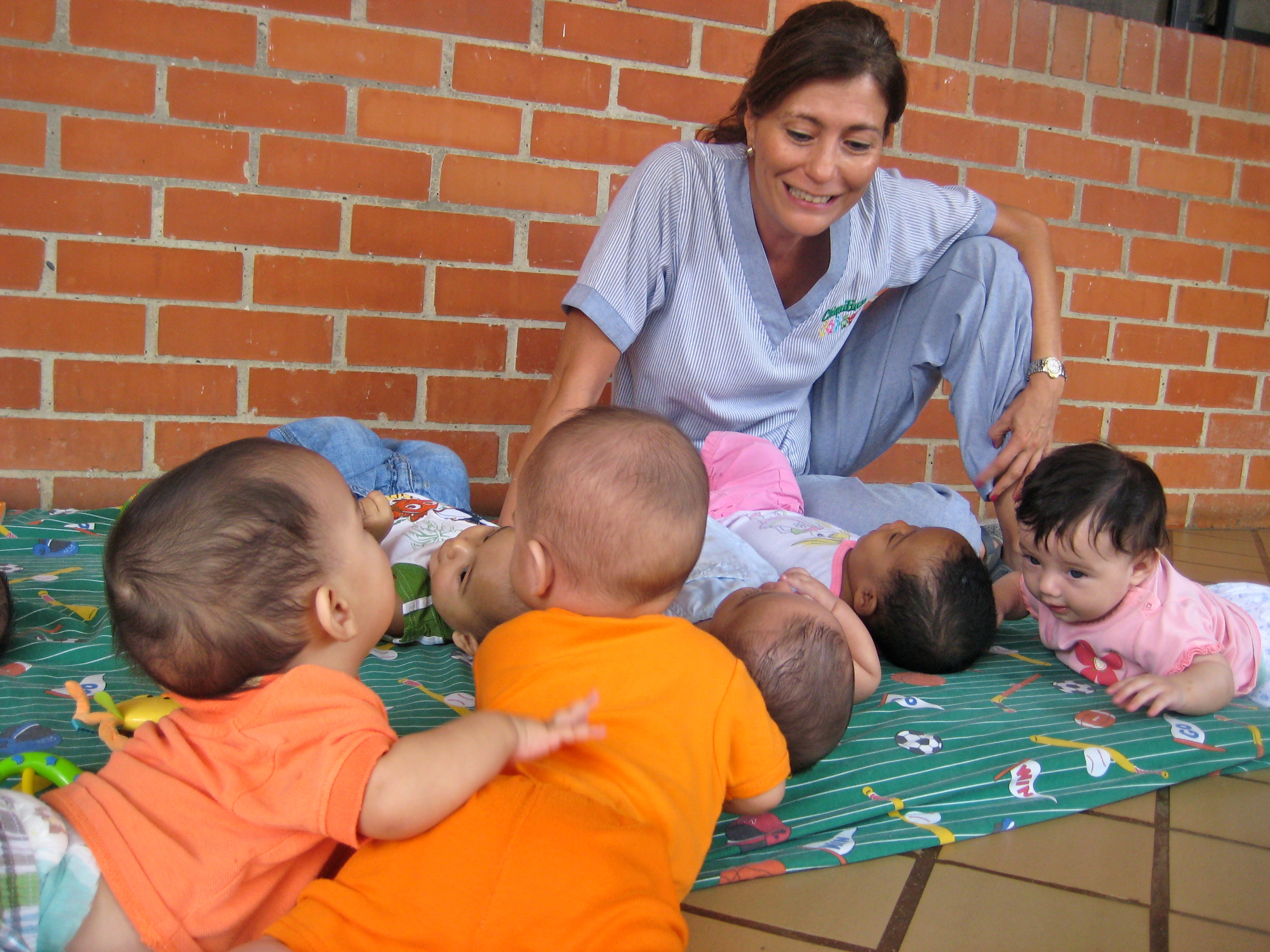
Talk about tummy time! It is so good for these little ones to be on a flat surface with toys to explore and learn from. In contrast to the baby slings that provide absolutely no opportunity for exploration aside from self-rocking (which is not conducive to learning how to sit independently) and which often leave the babies slouched at all sorts of horrible angles, tummy time promotes purposeful movement and interaction with the environment that these little ones so desperately need. Forget having to gently place them back on the mat every two minutes as they wander off into new territory – it is totally worth it to see them playing and exploring and learning!


On Thursday, I overheard a volunteer telling one of the caregivers why playing on a mat was better than spending time in the rocker chairs. The way she presented this newly acquired information so matter of fact made me grin to myself but I was one proud OT! I can’t say enough good things about the volunteers at Chiquitines. They are such a blessing!

-Abby

Playtime

It wasn’t all babies and gait trainers and hospitals and orphanages… there was a little tourist time too.  On Friday night we went to a show that is best described as salsa meets the circus called Delirio. It is quite an espectaculo! And Abby and I were quite the spectacle. As you enter the show you go this kind of ”red carpet” experience and are handed drinks (chivas and aguardientes… not for the faint of heart) and have several photo ops.  And if you are two gigantic curly-headed girls, the photo ops are aplenty!


Saturday was filled with shopping and driving tour of Cali.  Mercedes, who you all might remember as Negra, Magnolia’s good friend that I lived with last year, has moved to a super fancy high-rise on the hill overlooking all of Cali. We made sure to stop there! Here is a picture of the view from her balcony.


It was amazing to be in that setting, but it was also an amazing representation of the disparity of wealth in Colombia.  There we were in this fancy pants apartment (much nicer than anything I have ever lived in… not sure that is saying much though:) ) But immediately surrounding this huge new building were old dilapidated buildings like these:


The day was capped of with something long overdue: the mango taste test.  I am, well a mango aficionado of sorts… or better put I want to be one.  I love mangos.  And have obsessed over them several times in previous posts.  What amazed me when I got here last year was to learn that there are so many different types.  Its like apples back home.  Any typical grocery store or market is sure to have at lest 3-4 different kinds of mangos.  I was really not even sure which ones are the type we usually eat at home. So last night Magnolia and one of her friends helped me put it to the test.


 And the winner is: Tomy- very sweet, not as many of those little stringy bits that get stuck in your teeth… and it was huge.
I had such a great time with my all my friends here in Colombia.  Here is a picture of my most loved Colombia Mother, Magnolia (as requested by my friends at CMC) who helped make this short trip so productive!! Mil gracias, te quiero y nos vemos muy pronto.

Magnoliacita

KO